
Relational databases have evolved. Modern multi-model databases go beyond tables, rows, and columns to become full-featured data platforms for application development.
In this article, we’ll explore 10 modern Oracle Database features that help build simple, robust data-driven applications.
Event Streaming
Real-time, asynchronous data processing is a cornerstone of modern app development – look at the success of Apache Kafka and other, similar streaming solutions.
However, event streaming doesn’t have to live outside the database. Oracle Database includes Transactional Event Queues (TxEventQ), a high-performance, transactional event streaming platform that runs directly in the database.
- Guaranteed delivery: Messages are durable, ordered, and transactional, ensuring exactly-once processing.
- Polyglot consumption: Publish and subscribe using Java, C, Python, REST, or Oracle’s Kafka-compatible Java client implementation.
- SQL integration: Events can be queried with SQL, joined to relational data, or combined with JSON and AI features in the same database.
- Elastic scaling: TxEventQ scales throughput automatically across database instances in Oracle RAC or Autonomous Database.
Event streaming and TxEventQ are complex topics – but code samples make everything easier. Check out my repo of samples for Kafka APIs, JMS, SQL, and REST. I also have a dedicated section for TxEventQ articles.

JSON Document Data
Many service architectures I’ve implemented in the past included both document and relational databases, due to the demand for both data structures. The need for both types of databases also drove complex requirements for data synchronization and communication.
Multi-model databases don’t force you to use relational OR document data – you can easily use both, side-by-side.
- Native JSON data type: Store JSON documents efficiently alongside your relational data.
- Dual modeling with JSON Relational Duality: Access your relational data as JSON documents.
- SQL and JSONPath queries: Query JSON documents with familiar SQL operators or JSONPath expressions.
- Indexing and performance: Take advantage of functional indexes, full-text search, and in-memory processing for high-performance JSON workloads.
There’s also the wire-compatible MongoDB API – you can connect to your database server as if it was MongoDB, no client side changes required.
When you combine the capabilities of relational and document databases in a single platform, it simplifies (or even eliminates) the complexity associated with multiple data platforms.

Multitenant Architecture
Distributed application architectures have many services, each accessing or managing different data.
Oracle Database’s multitenant architecture lets you consolidate multiple databases into a single container database (CDB), while keeping each workload isolated in its own pluggable database (PDB). This design simplifies management, improves resource efficiency, and supports distributed service design.
- Resource isolation: Each PDB has its own memory, CPU, and storage quotas, preventing one workload from impacting others.
- Simple bounded context: Logically group services into their own PDBs within the same CDB.
- Scaling: Add new PDBs to the container database as demand grows, without reconfiguring existing databases.
Database as Cache
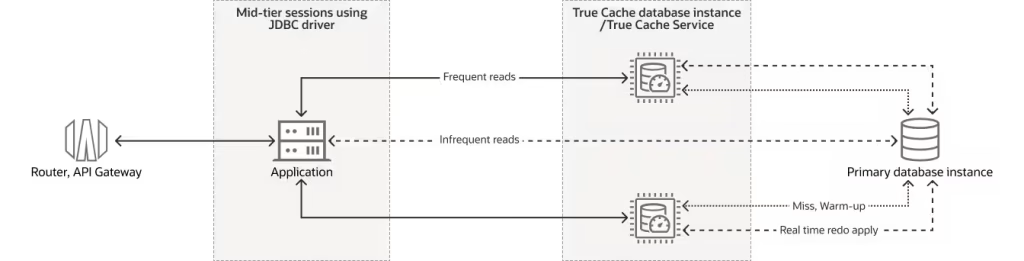
We often reach for a caching server when designing application architectures to improve latency and reduce load on our primary database. But what about using the database platform itself as a cache?
Oracle True Cache configures additional database servers as automatically managed, read-only replicas of your primary database. Writes hit the primary database, and reads hit the cache – all using the same SQL drivers/queries.
- Memory-first architecture: Frequently accessed data is stored in memory for microsecond-level reads, accelerating application performance.
- SQL integration: Because it’s the same database platform, queries, joins, and transactions work directly against cached data with no application changes required.
- Simplified architecture: Eliminates the need for separate caching layers like Redis or Memcached in many workloads, and automatically synchronizes cache data.
Automatic REST APIs
When you have a database schema, you often need secure CRUD APIs for that
Oracle REST Data Services (ORDS) is free-to-use Java EE server that extends Oracle Database with RESTful services. With ORDS, you get out-of-the-box functionality for your database instance:
- Database management REST APIs
- SQL Developer (web)
- Wire-compatible MongoDB API
- Extensible REST APIs for your data
- Security features like OAuth 2.0 support for custom IDPs, JWTs, and more.
ORDS’ Auto REST capabilities, turn turn a database schema into a RESTful webservice using only a few lines of PL/SQL and zero backend code.
AutoREST works great with both your relational and JSON document data, exposing either as RESTful APIs.

AI Vector Search
AI-powered workloads make frequent use of vector databases and semantic search. Vector databases are ideal for uses cases like recommendation systems, image recognition, and natural language search.
- Native vector data type: Store vector embeddings alongside relational and document data.
- Vector indexes: Perform similarity searches at scale with specialized indexes optimized for the distance algorithm of your choice.
- Integrated SQL queries: Combine vector search with SQL filters, joins, and aggregations for complex queries.
New to vector databases? Read What’s a Vector Database? for a primer, or check out a sample application implementing AI vector similarity search.

Geospatial and Graph
Geospatial and graph capabilities are used to model complex relationships, analyze networks, and work with location-based data.
Often, these features are offloaded to specialized graph or spatial databases. However, multi-model databases integrate spatial and graph with traditional relational queries, within a single platform.
- Property Graphs: Model networks, social connections, or supply chains with SQL-style graph queries.
- Graph algorithms: Run shortest-path, centrality, community detection, and other algorithms directly in the database.
- Spatial data types: Store points, lines, polygons, and 3D objects for mapping, routing, and geofencing.
- Spatial indexing: Accelerate spatial queries with R-tree and other optimized indexes.
- Integration with SQL and JSON: Combine geospatial and graph analytics with relational or document data for richer insights.
References:
In-Database JavaScript
If you don’t like writing SQL or stored procedures, the Multilingual Engine (MLE) allows database procedure definition in JavaScript, powered by GraalVM.
- Native JavaScript execution: Write JavaScript stored procedures, functions, or scripts without leaving the database.
- SQL integration: Call JavaScript code from SQL or PL/SQL, and use database objects (tables, JSON, or vectors) directly.
- Simplified architecture: Reduces the need for external application servers for certain workloads, letting you run data-intensive logic close to the source.
While JavaScript is supported currently, I expect other languages will be integrated into MLE in future releases.
Observability and Monitoring
App architectures require deep visibility into database performance and health. Complementing existing monitoring solutions, the Oracle Database Metrics Exporter exports configurable OpenTelemetry metrics for your database instances.
- Out-of-the-box metrics for database performance and resource usage.
- Flexible deployment in containers, Kubernetes, or standalone binaries.
- Multi-database support from a single exporter instance.
- Secure authentication via TLS, Oracle Wallet, or cloud vaults.
- Custom metrics defined with SQL, plus Grafana dashboards to get started quickly.
This makes it easy to plug Oracle into modern observability stacks like Prometheus, Grafana, and cloud logging systems.

Container-based Testing
Lastly, let’s look at testing support. I’m a big advocate of testing, and writing good tests for your database apps is extremely important.
Thankfully, frameworks like Testcontainers make this easy without clunky test scaffolding. Add the library to your project, and write your tests against disposable, containerized database instances.
Try out a collection of Testcontainers code samples with Oracle Database Free, or learn more about Testcontainers.

Final Thoughts
Adopting features of multi-model database platforms presents a tradeoff compared to a distributed system component architecture.
Because modern multi-model databases are capable of most functions traditionally done by distinct systems/components, you can potentially use just one database instead of N (assume N is a large number).

Tradeoffs
- Co-location and queryability of data: If I use a multi-model database, all my data is accessible and joinable through common SQL queries without any middleware or external complexity.
- Common platform for developers: Each development team is using the same tooling and data platform, fostering collaboration and cross-team efforts. Many of our problems revolve around shipping or transforming data from one system to another. A heterogeneous data platform resolves this.
- Less operational overhead: My ops team only needs to manage one data platform rather than N. In my experience, distributed systems increasingly grow in operational complexity as teams add more and more data systems. The multi-model database offers a chance to cut this down to only 1.
On the other hand… you may want to avoid tightly coupling ALL your data in one place for performance, scalability, and single-point-of-failure reasons.
These concerns are somewhat ameliorated with Oracle through features like globally distributed database, cluster/node level transaction isolation (e.g., running all my vector calculations on a single node/cluster segment), schema isolation (PDBs), and basically infinite scalability with Exascale.
References
- TxEventQ samples for Kafka APIs, JMS, SQL, and REST
- Collected TxEventQ articles
- Native JSON data type
- JSON Relational Duality views
- Wire-compatible MongoDB API
- Pluggable database (PDB) Multitenant architecture
- Oracle REST Data Services (ORDS)
- OAuth 2.0 support for custom IDPs, JWTs, and more with ORDS
- ORDS AutoREST for relational data
- ORDS AutoREST for JSON data
- Oracle Spatial guide
- Integrated graph database
- Multilingual Engine (MLE)
- Oracle True Cache
- Oracle Database Metrics Exporter
- Learn more about Testcontainers
- Testcontainers code samples with Oracle Database Free
Leave a Reply