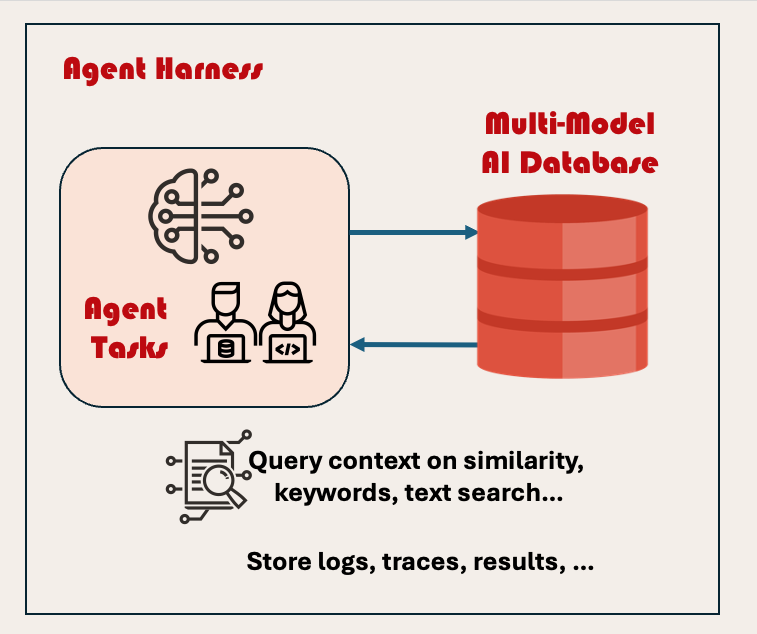
Long-running agents often fail because they lack disciplined, accurate context. This is especially important when tasks run for hours, touch multiple systems, and must respect permissions, compliance boundaries, and other constraints.
When building with agents, data is context, and context is critical. Where does this data most often live? Your database.
What is an “agent harness”?
An agent harness is the execution environment and control layer around an LLM agent that turns LLMs into systems that can reliably do work.
Agent harness makes workflows safe, repeatable, and correct. You can think of agent harness as the agent’s runtime, responsible for:
- Orchestrating tasks into steps by choosing tools and sequencing actions.
- Managing state over the lifetime of the task, including planning, progress, logs, and results.
- Calling tools/APIs (search, code execution, ticketing, DB queries) and normalizing outputs.
- Guardrails for agent permissions, data access, sandboxing, and safe tool use.
- Observability of logs/traces, metrics, errors, retries, timeouts.
- Integrating memory by managing “hot” working memory, long-term storage, maintaining a source-of-truth.
For a given task, this might look like:
plan → query context → tool calls → checkpoint → audit/write-back.
Frameworks like DeepAgents or custom orchestration code can serve as an agent harness, but harness is an architecture not tied to a product.
How do databases fit in the picture?
Databases typically play three distinct roles in an agent harness. The key is that “database” ≠ “vector DB only”.
Source of truth (structured memory)
Use structured data (ideally from a relational model) when agents need agent authoritative facts and consistent answers, especially in multi-tenant models.
- The agent can query the current state of the system instead of guessing.
- The database provides transactions (ACID), concurrency, integrity constraints, and governance
This makes it much easier to reason with distributed data in real systems, such as business data:
- users, permissions, entitlements
- orders, contracts, tickets, inventory
- timestamps, audit trails, SLAs
Another benefit of this source of truth is that your business data is usually already stored in your database system.
Retrieval layer (associative / long-term memory)
Databases offer powerful search capabilities, like filtering, vector similarity, and full-text search. Modern AI Databases combine these search techniques with a vast amount of structured data types:
- The agent harness can do pre-LLM filter queries (keyword + metadata + similarity) so only the top-k snippets enter agent context.
- Hybrid retrieval further boosts search across multiple data types.
AI Databases retrieval techniques are ideal for querying complex business documents using embedings, text queries, and keyword metadata:
- policies, procedures, knowledge articles
- code/documentation corpora
- historical cases/incidents
A hybrid query example combining filters and semantic ranking
SELECT doc_id, title
FROM documents
-- filter multi-tenant documents by region
WHERE tenant_id   = :tenant
  AND region      = 'APAC'
  AND record_type = 'contract'
-- order results by similarity to initial query
ORDER BY
  vector_distance(embedding, :query_embedding, COSINE) ASC
FETCH FIRST 20 ROWS ONLY;Operational backbone for the harness itself (telemetry + governance)
Agents consume a lot of data as context, but they also produce a lot of data. As an agent works on a task, it may produce data like:
- Conversation/session metadata (full or partial transcripts)
- Tool call logs, traces, intermediate or final results (stored independently or as a call graph)
- Security events and audit records
- Job queues and scheduling state
Storing this kind of data in the database allows you to reliably monitor, retain, and audit agent processes – vitally important for traceability, debugging, and “what went wrong” moments.
Sandboxed filesystems, while efficient, are ultimately more difficult to scale, maintain, and monitor than databases.
Where filesystems fit (and how the harness chooses)
A good agent harness usually uses a tiered approach:
- Filesystem / workspace = working memory: fast, flexible scratchpad (plans, intermediate outputs, ephemeral artifacts).
- Vector/FTS in a database = recall: find relevant prior knowledge efficiently.
- Relational database = truth + policy enforcement: hard facts, permissions, and governed state.
The harness is the component that decides:
- When to read local files vs query a database
- How much to retrieve (top-k, token budgets)
- How to ensure freshness (index sync / re-embed pipelines)
- What the agent is permitted to access
Ideally, database capabilities are be combined in a modern, multi-model database like Oracle AI Database that supports many data types and query capabilities to simplify/augment storage and retrieval.
High-level Summary
- Harness = brainstem/executive function (controls actions, checks rules, maintains state)
- Filesystem = scratchpad
- Database = library + ledger (retrieval + authoritative records + auditability)
What databases do for the harness
- Precise filtering before tokens: prune using exact predicates and joins so only relevant context reaches the model.
- Hybrid search: combine full-text ranking, vector similarity, and structured predicates in a single query plan.
- Policy and security: enforce who can see what with row-level controls and encryption; audit every access.
- Data integrity: ACID updates, indexes that track change, pipelines to keep embeddings current.
- Observability: durable logs of what the agent retrieved, when, and why. This is essential for debugging and compliance.
A multi-model database like Oracle AI Database includes features (events, vectors, text search, relational/nosql, etc.) that make it ideal for integrating agent harness data. Expect a follow-up article that dives into these capabilities!
Leave a Reply