Developers need the shortest path from claim to proof. Can I start a database locally? Can I connect from my app? Can I run my tests against it? Can I inspect the schema without guessing? Can I use it with scripts, agents, and CI? Can I easily move from a laptop to a managed cloud database?
In this article, we’ll look at tools that help you shorten the feedback loop for the development process you’re trying to prove.
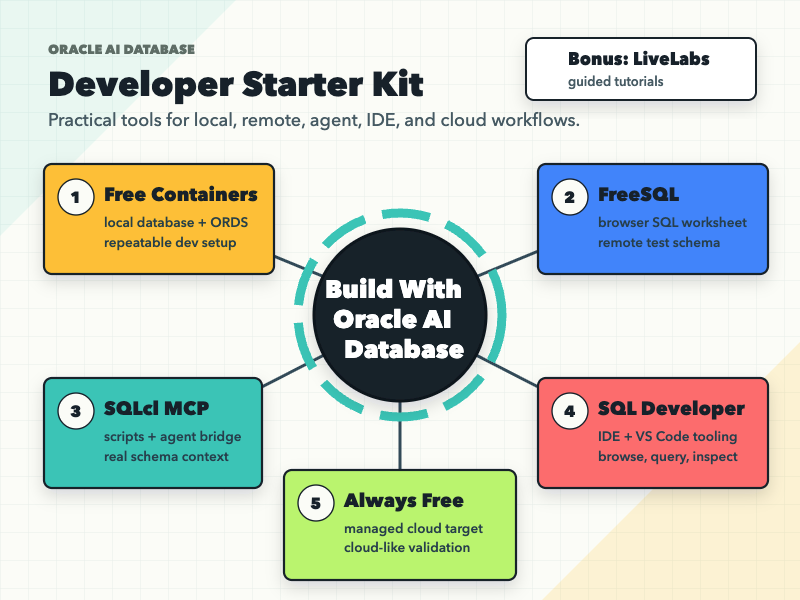
Here are the five I would put in a practical starter kit. These are tools I use every day.
- Oracle AI Database Free Container Images
- FreeSQL
- SQLcl MCP Server
- SQL Developer
- Always Free Autonomous AI Database
Oracle AI Database Free Container Images

Start local when you can. While the database container images are around 4-5 GB, they are multi-arch and start quickly for easy dev workflows.
The Oracle AI Database Docker Compose sample spins up a disposable database on localhost:1521. It’s enough for a most app development: point your app at the container database and fire away. When you’re done, throw the container away.
I like containers a lot and use them constantly for development work. Here are some more Oracle-specific container resources:
- For API work, try Oracle REST Data Services (ORDS) with Docker Compose
- For Testcontainers developers, try both Oracle AI Database Free and ORDS in your test suites.
Use containers when:
- you need repeatable local development
- you want integration tests that create and destroy their own database
- you are testing a feature before moving it into shared infrastructure
- you need ORDS locally for REST, JSON, or SQL Developer Web workflows
Containers help you proof your code, schema, and assumptions on a clean database environment.
FreeSQL

Sometimes the right local setup is no local setup.
Oracle FreeSQL gives you a browser-based SQL environment for learning, testing queries, and sharing examples without installing a database first. It is a good tool when the goal is to remove setup friction.
With a free account, you get a personal schema and can connect from tools such as SQLcl, VS Code, and application code. I covered that workflow in Use Oracle FreeSQL as a remote test database.
Use FreeSQL when:
- you are learning SQL or teaching someone else
- you need a remote schema without provisioning cloud infrastructure
- you want to test a query from a browser
- you want a simple database target for examples, demos, or agents
FreeSQL is a low-friction place to start proving small things.
SQLcl MCP Server

SQLcl is one of the first tools I install for Oracle AI Database work.
It is fast, scriptable, and useful for normal database development. You can run SQL, execute setup scripts, inspect objects, export data, load data, and automate validation without opening a full IDE.
Now SQLcl also matters for AI-assisted development. Oracle describes SQLcl as a free command-line interface with an integrated MCP Server, and the SQLcl MCP Server documentation explains how AI clients can use saved SQLcl connections to discover database context and run database operations through a structured MCP interface.
Use SQLcl when:
- you want a reliable command-line SQL tool
- you need repeatable scripts for setup, validation, or data loading
- you want an MCP bridge between an AI assistant and Oracle AI Database
- you want agents to inspect real schema metadata instead of guessing
- you can give the tool a constrained database identity instead of broad credentials
The Oracle Deep Data Security technical brief is aimed at the agentic AI problem: applications and agents connecting to data, dynamically generating SQL, and potentially bypassing application-layer assumptions. The practical idea is simple: enforce authorization at the data layer, not only in the app or the prompt.
SQL Developer

SQL Developer compliments SQLcl, providing additional features beyond the capabilities of the command line.
Most database developers eventually need a visual tool for browsing schemas, inspecting rows, reviewing objects, writing SQL, debugging PL/SQL, or explaining something on a screen share.
SQL Developer is Oracle’s tool family for that job. If you want a dedicated database IDE, use standalone SQL Developer. If your day already lives in VS Code, use SQL Developer for VS Code and keep database work closer to your application code.
Use SQL Developer when:
- you want to browse schemas and database objects visually
- you are writing or debugging SQL and PL/SQL
- you need to inspect data quickly
- you want Oracle AI Database tooling inside VS Code or as a standalone app
Always Free Autonomous AI Database

Some work needs a managed cloud database.
Always Free Autonomous AI Database is what I use when I need something closer to a real cloud deployment.
It’s great for personal projects, demos, APEX work, ORDS work, cloud-native experiments, and validation that needs to include cloud connectivity. You get to test wallets, network rules, deployment behavior, and managed database operations.
The tradeoff is that it’s a managed cloud: You need an OCI account. You need to understand wallets, network rules, and free tier quotas. Always Free is not production capacity, and treating it that way will lead to bad assumptions.
Use Always Free Autonomous AI Database when:
- you need a persistent managed Oracle AI Database environment
- you are building demos or personal projects
- you want to test wallet-based connectivity
- you need to validate cloud deployment behavior before using paid resources
Bonus: LiveLabs Training And Tutorials
Tools are easier to adopt when there is a guided path.
Oracle LiveLabs gives you hands-on labs and workshops across Oracle technologies. It is useful when you want more than documentation but less than a full course.
Use Oracle LiveLabs when:
- you are learning a feature for the first time
- you want a guided workshop before building your own version
- you need training material for a team
- you want examples that connect product features to real tasks
Start Small And Prove One Thing
The goal isn’t to collect Oracle tools.
The goal is to keep the development loop short: write code, run SQL, inspect results, automate the boring parts, and move from local to cloud without changing the way you think about the database.
Leave a Reply