
Pub/Sub in the Database? Yes — Here’s Why.
In this article, we’ll discuss how to use your database for event streaming with Oracle Database Transactional Event Queues (TxEventQ), a built-in, database-native message broker.
TxEventQ supports multiple consumers/producers, exactly-once messaging, partitioned queuing (key based and automatic), and strict ordering per message stream.
TxEventQ is included in every Oracle Database version from 21c onward, including Oracle Database Free.

What are Transactional Event Queues?
TxEventQ is built into the database and backed by a specialized, sharded table architecture.
This means event streams in Oracle Database can take full advantage of advanced database features:
- High availability with Real Application Clusters (RAC) and Active Data Guard
- Advanced security and mTLS from clients
- Transactional, exactly-once, atomic messaging semantics
- Event data is queryable and interoperable with plain SQL
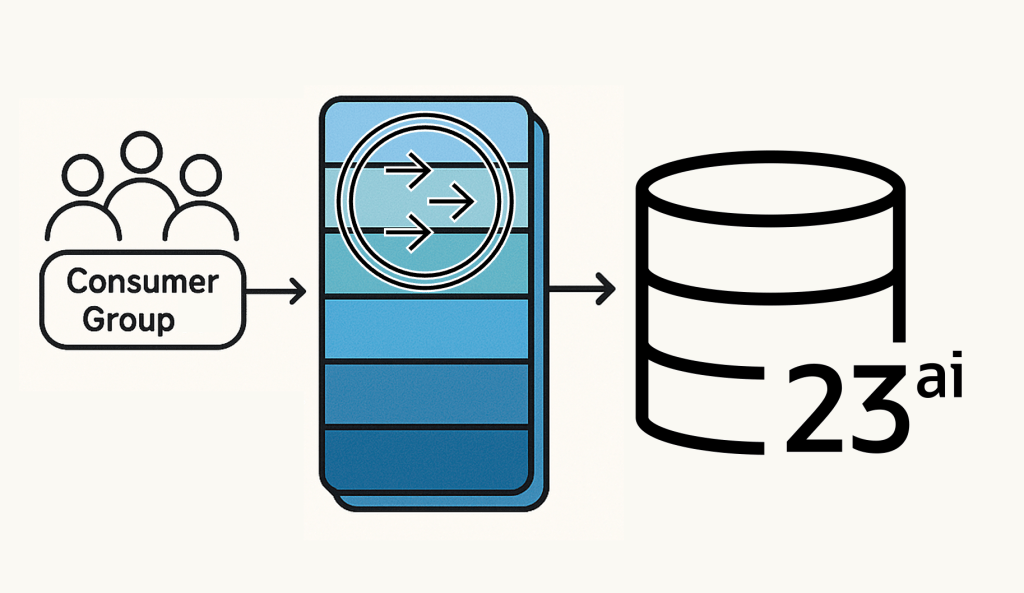
Client APIs work anywhere you have a database client – in common languages like Java, Python, Javascript, C, .Net, and PL/SQL.
Familiar with Apache Kafka? Use the Kafka Java Client for Oracle Transactional Event Queues, or produce/consume events over REST with Oracle REST Data Services (ORDS).
High-throughput installations of Transactional Event Queues have been benchmarked at up to 1 million messages per second on an 8-node Oracle RAC Database.
Why use Transactional Event Queues instead of another message broker?
There are many messaging systems on the market, both proprietary and open-source, with different goals, capabilities, and limitations:
TxEventQ shines when you want to leverage the existing capabilities of the database for robust, exactly-once messaging:
- Simplified Infrastructure:
- No separate Kafka cluster or heavy middleware required.
- Runs where your Oracle Database runs, minimizing moving parts.
- SQL-Native Compatibility:
- Event streaming, CDC, and queries work with familiar SQL.
- Developers don’t have to learn a new API surface to participate in event-driven systems.
- Transactional Messaging:
- Database changes and event publishing happen atomically with transactional integrity.
- Guarantees exactly-once semantics, solving the dual-write problem.
Why have some users adopted TxEventQ?
Developers choose TxEventQ because it solves common pain points in building event-driven applications:
- Running your message broker in the database allows you to eliminate the need for separate, costly servers dedicated to event streaming. These servers require domain-specific knowledge to operate, maintain, and upgrade in production deployments.
- Combining messaging operations with inserts/updates of related data in a single transaction is incredibly simple and powerful: no headaches about data loss or corruption.
- The transactional integrity of TxEventQ is incredibly important to users working with data that requires exactly-once semantics: They need strict guarantees and transactional messaging.
Teams that need simplicity, reliability, and tight synchronization between data and events adopt TxEventQ because it reduces moving parts and keeps messaging as reliable as the database itself.
How to build apps using TxEventQ?
If you’re using Java, start with the Kafka Java Client for Oracle Transactional Event Queues — Familiar Kafka APIs make working with TxEventQ simple when creating topics, publishing events, and consuming events.
Sample applications using TxEventQ
These code samples help you get started developing applications using TxEventQ using various paradigms (REST, SQL, clients) and programming languages.
- Kafka Java APIs
- Spring Boot + JMS
- Plain JDBC Event Streaming
- CDC with Spring Boot
- TypeScript producer/consumer
- Oracle REST Data Services (ORDS)
Transactional Event Queue SDK and implementation references
Oracle maintains a number of other clients and reference information for using Transactional Event Queues. Most Oracle Database drivers (Java, Python, NodeJS, etc.) include support for Transactional Event Queues.
- Java API Reference
- Python API Documentation
- NodeJS API Documentation
- .NET Developer’s Guide
- Oracle Database PL/SQL Packages and Types Reference
- Oracle Database Advanced Queuing Java API Reference
- Spring Cloud Stream Binder for Transactional Event Queues
- Transactional Event Queue Kafka Connectors
Questions? Let me know in the comments section, or reach out directly.


Leave a Reply